The true father of the Caroline age in Anglican theology was Lancelot Andrewes, the “mystical theologian” par excellence of the English Church. Though legally bound 23 to worship according to Elizabeth's 1559 revision of the 1552 Prayer Book, the usage of his own private episcopal chapel was to become influential within the high church tradition. Andrewes restored many of the best features of the traditional pre- 24 Reformation order of Mass. The focal point of his chapel was a prominent, lavishly adorned, east-facing altar, separated from the rest of the church by an altar rail. Andrewes restored many of the old vestments, as authorized by the Elizabethan “Ornaments Rubric” as well as traditional liturgical vessels, including a Gothic style chalice and paten. Frankincense was offered, as in the old Mass, in a golden censer.
The ceremonial of his chapel also brought back many rituals of eucharistic offertory, including an offertory of the eucharistic gifts clearly differentiated from the reception of alms and the old ceremony of mixing water with the wine. Andrewes' doctrine of eucharistic offertory was vividly illustrated in the image which hung above his altar, depicting the story of Abraham and Melchisedech, and thus 25 recalling the Supra quae propitio of the Roman Mass.26
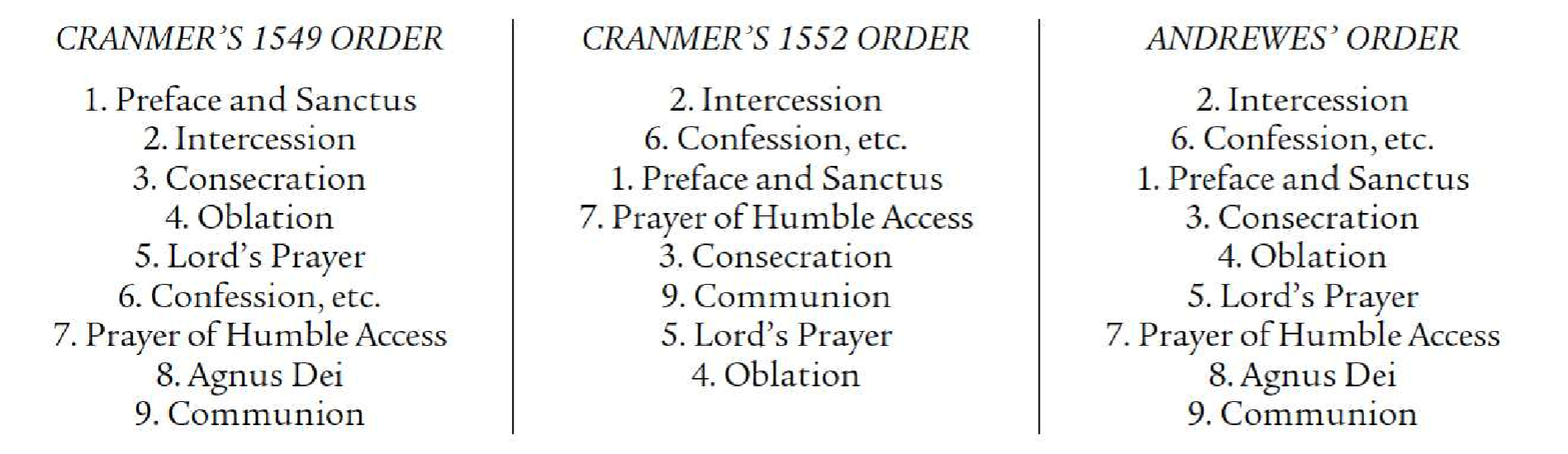
Within the Prayer of Consecration, Andrewes restored the old manual acts, retained in 1549 but omitted in 1552. Perhaps more importantly for the development of the Anglican Liturgy, Andrewes skillfully reordered the prayers of the 1552/1559 Liturgy, so as to transform it from being a series of Communion devotions into a true Liturgy, after the patterns of Christian antiquity. The following chart shows Andrewes' order as compared to 1549 and 1552:
Further, Andrewes had no scruples about the occasonal replacement of the somewhat sparse, flat Cranmerian Prayer of Oblation (“O Lord and heavenly Father, we thy servants entirely desiring thy fatherly goodness”) with the Anamnesis of the Liturgy of St Basil, one of the most stupendous in all of Christendom. Finally, it is 27 entirely possible that Andrewes restored prayer for the dead in the context of the eucharistic prayer, since in his private devotions he prayed for the departed, and affirmed in his apologia to Cardinal Perron that the Eucharist is a sacrifice offered for the quick, the dead, and even the unborn.