Article 7. (Supplement) Women's Ordination and the Ordinal
A Supplemental Essay to Article 7
Note: Throughout our commentary of the Jerusalem Declaration we have affirmed its hermeneutic. In Supplemental Essays, we offer individual perspectives on how to apply these principles we seek to promote across the Communion. cf., Article 7 Commentary: On the Historic Succession and Ministry
By The Ven. Andrew Brashier
What’s Past is Prologue – The Preface to the Ordinal
Archbishop Thomas Cranmer, in orchestrating the 1549 Book of Common Prayer, authored a wonderful preface to the Ordinal that has remained in each edition of the classic prayer books, including the authoritative 1662 edition, with only minor updates to his original text. He begins, as all Anglicans should, by rooting the Ordinal in the Scriptures, as received by the ancient Church: “It is evident unto all men diligently reading holy Scripture and ancient Authors, that from the Apostles’ time there have been these Orders of Ministers in Christ’s Church; Bishops, Priests, and Deacons.” [1] It follows, then, that the lens for us to understand these orders ought to be the Holy Scriptures themselves. The Ordinal’s lessons for ordaining deacons (1 Timothy 3:8-13 or Acts 6:2-7 and Luke 12:35-38), priests (Ephesians 4:7-13 and Matthew 9:36-38 or John 10:1-16), and bishops (1 Timothy 3:1-7 or Acts 20:17-35, and John 21:15-17 or John 20:19-23 or Matthew 28:18-20) are each tied to the Scriptural requirements, duties, and callings for each office. Likewise, the examination of ordinands follows Scripture’s requirements; therefore, the Word of God is crucial to understanding the Anglican reception of holy orders.
The plain reading of the appointed Scriptures, exhortations, and vows for the ordination rites notably echoes a common catholic requirement before proceeding with the laying on of hands: they must be men. After all, “The Bible is to be translated, read, preached, taught and obeyed in its plain and canonical sense, respectful of the church’s historic and consensual reading.” (Article 2, Jerusalem Declaration). The Ordinal’s rites and rubrics illustrate how the historic and consensual, reformed catholic Anglican Church receives and understands God’s revelation in His Holy Scriptures. For example, the first rubric in the 1662 Ordinal’s Preface states that candidates for each office must be a “man” of a certain minimum age. A deacon cannot be eligible to the priesthood, unless “ he …continue in [the] office of a Deacon the pace of a whole year.” A candidate to the episcopacy is referred to as “Brother,” by the Archbishop. Before one objects that this is simply a matter of nouns and pronouns, remember the old adage: lex orandi, lex credendi, lex vivendi. As we pray, so we believe, so shall we live.
Reading Scripture with Ancient Authors
Since what we pray is what we believe, reforming any liturgy is not a task to take lightly, nor should we rush into any changes. Therefore, Archbishop Cranmer carefully and dutifully reformed the Ordinal without altering the received catholic tradition reflected in the Holy Scriptures. Namely, Cranmer and later Anglicans refused to deviate from the practice of only admitting qualified men to holy orders. Future prayer book revisions were careful and intentional over the centuries to retain this truth, as summarized in Cranmer’s original Preface:
Which Offices were evermore had in such reverend Estimation, that no man might presume to execute any of them…, [and] no man shall be accounted or taken to be a lawful Bishop, Priest, or Deacon, in the Church of England.
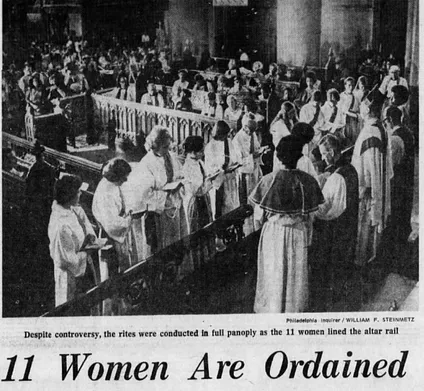
This offends modern sensitivities both outside and even within the Global Anglican Communion. However, we must obey the plain reading of Scripture received by the ancient Fathers and reject novelties arising a mere fifty years ago, namely, women’s ordination, with especial concern towards the presbyterate and episcopacy.[2] The Ordinal’s lessons are clear: each order is bound to Scriptural injunction for the cleric to be the “husband of one wife” (literally a one-woman man), the first seven deacons were men chosen by the Twelve Apostles, the Twelve Apostles were men directly appointed by Christ to minister, preach, evangelize, “plant” and oversee the churches, the Eleven expressed qualities for a replacement for Judas and selected another man to replace Judas,[3] and before their deaths, the Twelve Apostles empowered qualified men to lay hands on those qualified for the ministry. Or to put this another way, since Jesus Christ instituted and is head of His body,[4] the Church, and He purposely called men, and gave those same Apostles His Holy Spirit, and by the Holy Spirit inspired those Apostles to write Holy Scripture,[5] which has traditionally been received as limiting holy orders to men, then how dare we oppose our Lord? The Holy Spirit is not the author of confusion and discord, nor does He ever speak a new revelation contrary to what has been revealed definitively in God’s Word written. God’s final revelation is His Son, Jesus Christ, as revealed in the New Testament. The Holy Spirit, who inspired and authored the New Testament Scriptures through the Apostles, would not sow division and disunity nearly two thousand years later, denying what He revealed to the Church millennia ago. When the Spirit speaks, it is to point, affirm, and enlighten us as to the Son. The “Spirit of truth” is never contrary to the Son, “for he will not speak on his own authority, but whatever he hears he will speak.”[6]
Male-only orders are how the Ordinal, English Reformers, Caroline Divines, Restoration-era revisers received the Scriptures and catholic faith, our modern sensibilities be damned. Altering the Ordinal’s qualifications is not merely updating or modernizing a rite; it is changing the unchangeable faith revealed in Scriptures and preserved in the catholic tradition. Let us attend to the words of the Golden-tongued saint, John Chrysostom:
For those things which I have already mentioned might easily be performed by many even of those who are under authority, women as well as men; but when one is required to preside over the Church, and to be entrusted with the care of so many souls, the whole female sex must retire before the magnitude of the task, and the majority of men also; and we must bring forward those who to a large extent surpass all others, and soar as much above them in excellence of spirit as Saul overtopped the whole Hebrew nation in bodily stature: or rather far more.[7]
Do we dare to say we are wiser, more catholic, and more orthodox than the Great Doctor of the undivided Church, St. John Chrysostom, when it comes to who is eligible to the episcopacy and presbyterate? Have we dispensed with the Jerusalem Statement’s truth, “The doctrine of the Church is grounded in the Holy Scriptures and in such teachings of the ancient Fathers and Councils of the Church as are agreeable to the said Scriptures.” [8] The Jerusalem Statement echoes the Preface to the Ordinal, which upholds the “self-evident” nature of the threefold holy orders, limited to men, based upon “reading holy Scripture and ancient Authors.” [9]
We deviate from the faith once delivered if the Scripture’s catholic qualifications as universally received by the ancient fathers for nearly two thousand years are dispensed with and ignored in the name of equality, representation, or the zeitgeist—irrespective of whether the candidate is male or female. When the Church attempts to amend or dispense with Scripture’s truth, it must repent, for “it is not lawful for the Church to ordain any thing that is contrary to God’s Word written, neither may it so expound one place of Scripture, that it be repugnant to another.” [10] Therefore, the Global Anglican Communion must remain true to its claim in the Jerusalem Statement that the three formularies (39 Articles, 1662BCP, and its Ordinal) are where “such doctrine is to be found,” thereby maintaining the historic, ancient, orthodox, and catholic understanding of Scripture. Such an understanding—on this issue—is not Roman, nor Eastern, nor Protestant, but is properly catholic for the Magisterial Protestant Reformers, Rome, the East, Oriental Orthodox, and the Assyrian Church of the East, all agree. How dare we reinterpret, reinvent, and reverse Divine revelation?
The Jerusalem Statement claims: “We intend to remain faithful to this standard, and we call on others in the Communion to reaffirm and return to it.” [11] Where the Global Anglican Communion departs from these standards, it must repent and cease further aberrations and deviations from God’s revelation. This may seem harsh in our tender age, but the Truth is unchanging, for God is the same yesterday, today, and forever.^12b
Abiding by the Authority of the Ordinal
Is this Ordinal authoritative today? Yes. As Article 4 of the Jerusalem Declaration states, “We uphold the Thirty-nine Articles as containing the true doctrine of the Church agreeing with God’s Word and as authoritative for Anglicans today.” (Jerusalem Declaration). Article XXIII of the Thirty-Nine Articles states:
And therefore whosoever are consecrated or ordered according to the rites of that book, since the second year of King Edward unto this time, or hereafter shall be consecrated or ordered according to the same rites, we decree all such [who are ordained in accordance with the rites of the Book of Common Prayer] to be rightly, orderly, and lawfully consecrated or ordered.[12]
The Thirty-Nine Articles uphold the Ordinal (which predates the Articles of Religion) as authoritative. Since we recognize the Thirty-Nine Articles authoritatively, it follows that the Ordinal is an authority, or formulary. Further, the Ordinal and Articles of Religion dance in agreement with one another, as demonstrated in Article XXIII:
It is not lawful for any man to take upon him the office of public preaching, or ministering the Sacraments in the Congregation, before he be lawfully called, and sent to execute the same.[13]
It is no small matter for the Thirty-Nine Articles to say that those ordained in accordance with the Ordinal are rightly ordained. This is because we are ordaining no “new” thing, but only preserving the catholic orders which the Spirit empowers to preach the evangelical faith and administer the holy sacraments. Furthermore, whereas the Ordinal is attached to the 1662 prayer book, “and we uphold the 1662 Book of Common Prayer as a true and authoritative standard of worship and prayer,” Global Anglicans adhering to the standard should follow the catholic order of the Ordinal. (Article 4, Jerusalem Declaration). Simply put, as faithful Anglicans, we need to abide by the ancient Ordinal, for there is insufficient Scriptural warrant to deviate from it and follow practices that are a recent innovation to Apostolic Tradition and Catholic Order.
Where we as Global Anglicans depart from this scriptural warrant, we must repent. Otherwise, we are just as complicit in tearing the fabric of the communion. While Western Anglican provinces have, according to GAFCON’s Kigali Commitment, already “torn the fabric of the Communion,” [14] unless we in the Global Anglican Communion heed the Jerusalem Declaration’s lip service to authorities like the Ordinal, we will be to blame for further tearing the fabric of communion, and “without repentance this tear cannot be mended.” [15] We cannot boast about following the plain meaning of Scriptures in condemning same-sex blessings, while turning a blind eye as members of our own fellowship lay hands on what Scripture and the ancient Fathers do not endorse. There needs to be repentance, lest we sow the seeds of our own destruction.
Since, “Repentance defines and shapes the Christian life and the life of the church,” (Kigali Commitment), let us begin by “Recognising our own sins, and in humility as forgiven sinners… pray that those who have denied the orthodox Christian faith in word or deed would repent and return to the Lord” (Jerusalem Declaration, Article 13). Since those who teach will be judged more strictly (James 3:1), we call upon those provinces, dioceses, and leaders who have departed from biblical orthodoxy to repent of their failure to uphold the Bible’s teaching.” [16] Unless Global Anglicans address this issue today, then we will live in impartial communion at best, which is no real communion. This is simply not an issue Primates can dodge.[17] If we are to avoid the failures of the Canterbury Communion’s walking together while following different paths, we must obey the apostolic command to “have unity of mind” (1 Peter 3:8).
Preface, The Ordinal, 1662 Book of Common Prayer. For a detailed review on the role of deaconesses, Aime G. Martimort, Deaconesses: An Historical Study, Ignatius Press (1986). ↩︎
This focus does not dismiss the serious questions regarding obedience to Scripture and the ancient Fathers as to qualifications to the diaconate, but acknowledges 1968 Lambeth Resolution 32, which recommended women deacons. Unlike the diaconate, the innovative ordination of women as presbyters and bishops were both done without consultation or study by the wider communion gathered at the Lambeth Conference. Further, consciences are seared and serious theological questions arise as to the sacraments when innovative practices arise as to women presbyters and bishops. The question of whether one can be lawfully ordained by a woman bishop or whether the faithful receives Holy Communion when presided by a woman presbyter, for example. ↩︎
“‘So one of the men who have accompanied us during all the time that the Lord Jesus went in and out among us, beginning from the baptism of John until the day when he was taken up from us—one of these men must become with us a witness to his resurrection.’ And they put forward two, Joseph called Barsabbas, who was also called Justus, and Matthias.” Acts 1:21-23 (St. Peter speaking to the remaining Eleven). ↩︎
“For the husband is the head of the wife even as Christ is the head of the church, his body, and is himself its Savior. Now as the church submits to Christ, so also wives should submit in everything to their husbands.” Ephesians 5:23-24. ↩︎
“But the Helper, the Holy Spirit, whom the Father will send in my name, he will teach you all things and bring to your remembrance all that I have said to you.” John 14:26 ↩︎
John Chrysostom, On the Priesthood, 2:2 ↩︎
The Jerusalem Statement, at A Fellowship of Confessing Anglicans. ↩︎
Preface, The Ordinal, 1662 Book of Common Prayer. ↩︎
Article XX, Thirty-Nine Articles of Religion. ↩︎
The Jerusalem Statement, at A Fellowship of Confessing Anglicans. ↩︎
Article XXXVI, Thirty-Articles. ↩︎
Article XXIII, Thirty-Nine Articles. ↩︎
Global Anglican Future Conference: Kigali Commitment ↩︎
Ibid. ↩︎
Ibid. ↩︎
Women Bishops and Reception: An Occasion for Rethinking, The Rev. Dr. Stephen Noll, Anglican Compass, (Oct. 9, 2025) (available at: https://anglicancompass.com/women-bishops-and-reception-an-occasion-for-rethinking/) (“The question which the GAFCON Primates dodged, as I see it, is whether ordination of a woman bishop is, in the words of Canon A5, contrary to the teaching of the church as ‘grounded in the Holy Scriptures, and in such teachings of the ancient Fathers and Councils of the Church as are agreeable to the said Scriptures.’”) ↩︎